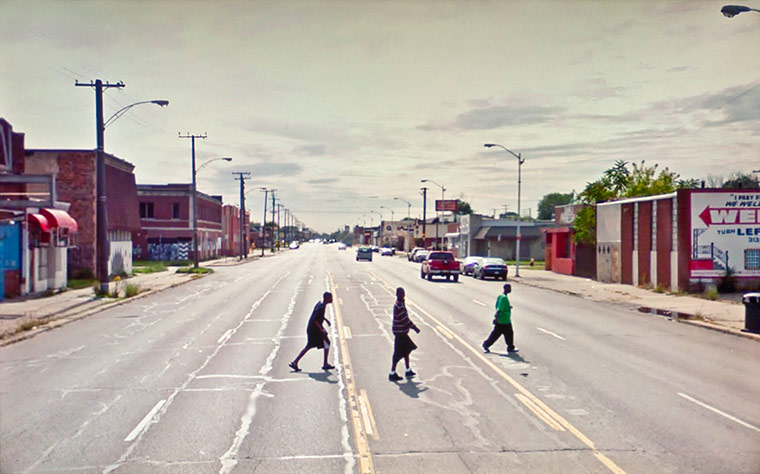
While lots of writing about new technologies portrays their use as revolutionary and new, here's an example of a new use retroactively affecting an existing activity. In this case, photography.
The Guardian recently ran a piece on how documentary photograph-minded users of Google Street View troll it for unintentionally resonant images of street life. They then display these found images as documentary photography.
Whatever you think of photographers (can they just sit and search for images?), this is a startling new use of an existing (new) technology, and right up the alley of really new media.
Monday, July 16, 2012
Wednesday, June 20, 2012
Coca-Cola? Here?
But, heck yeah, I'm still clean--the promotion actually isn't by Coke, but by a re-imagining/ updating of its (in)famous "Hilltop" ad from decades ago.
Some pretty cool really-new-media thinking. Its some of the best concepting I've seen since my all-time favorite (and still living in concept only) "Durex Baby."
Stretching QR Codes
Leave it to artists such as Yiyung Luto start to imagine new uses, and thus to bring the technology into the realm of really new media.
Integrating a QR code into each finished illustration takes users to a video stop-action animation of the making of that illustration.
See more at her website.
Thursday, June 14, 2012
It Tells a Story
A relevant story is something that already exists--the new media devices don't create it. But it is relevant to the market, and it meshes tightly with their lives. Because it is relevant to a target market, it is specific to it. There's no way to export a good use of new media generally, because the story it works with and within is specific, not general
Case in point is the Toyota campaign released in Belgium that works with Google Maps. It fits specifically the lives of people living in those narrow streets, and it works with their pride in living where they do, plus their desire to help put their neighborhood on the map.
Thursday, May 31, 2012
Yet another technology looking for a use
Leave it to the Aussies to extend (in this case) the social-media practice of trending (back) into the real world of people, bodies, and face-to-face discussion in one big, giant buzzing visualization.
Clemenger BBDO Sydney describes its project as "Mimeisthai - the world's first spoken-word trending engine."
Drop those smart phones, and forget texting, tweeting, etc. A series of mics throughout the auditorium picked up and digitized snips of f2f discussions, then crunched them into a visual representation of topics in conversation that were trending.
Like other examples noted here previously, it represents a great potential--if only now someone figured out a compelling use beyond a roomful of tech-nerds.
Thursday, May 3, 2012
Ignore the Cheesy Campaign Name
The QR code can only be scanned during certain times of the day.
It's some great thinking that takes this technology and adds relevance.
Thinking the Future iPhone
For example, pair the current craze for holograms (think augmented reality) with the craze for the iPhone.
What do you get?
Some pretty cool ideas about what could be.
Subscribe to:
Posts (Atom)