Really = truly. | Really New = current.
The heart of new media isn't the gadgets and code.
It's the thinking. The vision. And the seamless fit in what people already do.
Go somewhere else to read about gadgets and gee-whiz hardware.
For examples of great thinking and of envisioning new media, read on.

Search This Blog

Monday, January 13, 2014

Thirsty for something new?

It took a long time for some actually new really new media to come along, but it was worth the wait.

This billboard collects humid air (98% average humidity), then filters and supplies it to a spigot at its base, ready to be used by local residents who are woefully short of potable water.

It puts into action the appeal to innovative, forward-thinking applicants to this engineering program. It also brings a much-needed resource to residents.

In its dual-purposing of outdoor advertising, the way its use delivers the strategy, and in its wonderful boost to the quality of life of local residents, this installation really meets the bar.

Thursday, August 29, 2013

The Long Finger of a Friend

And we're not talking the middle one, either...
Have you always thought that texting to a friend or significant other that you're thinking about them was a bit cold?
As noted in Ad Freak, Goodby, Silverstein & Partners' GSP BETA Group has come up with a nice antidote to try to make this exchange of data a bit more human.
Once you and your friend or S.O. both download this nifty little app and entering a virtual room, when you both touch a spot on your phone, each phone vibrates.
Okay, so it's hardly a hand squeeze of support. :) But it shows some good thinking about how to bring the digital world in line (if only) a bit more to the human one. Hand squeezes, back slaps, etc. are ways that we try to give each other a little boost through the day. This makes it a remote activity but perhaps a less remote possibility.
While this is hardly a part of a campaign, it still represents some good really new media thinking by bringing the digital and the human just a bit closer together.

Thursday, August 1, 2013

How's It Look?

Envisioning furniture as it might look in your living room can be pretty tricky. Buying it because you think it might look good, then getting home to find out it doesn't, happens all too often.

IKEA's 2013 product catalog uses a number of digital technologies, but the use that caught my eye is how the catalog, a downloadable app and your mobile phone, tablet or computer combine to show you what a piece of IKEA furniture would look like in whichever room you want.

Unlike promotional uses of augmented reality technology in the past (GE's early effort comes to mind), this use of AR addresses the already existing need to get a good idea of how a piece of furniture might look. A nice example of really new media!

Tuesday, May 28, 2013

The Pacific TwiTrip

Sorry for the lag in posts over the past month or two. But you just can't rush perfection... And if there are few if any examples to post about, then let it lie.

Not like today, though.

Travel is always social. You're always meeting people and sharing with friends about the trip when you return. But this week The Guardian (UK) has launched a feature that lends itself well as an example of really new media.

The premise: Send two English reporters on a road trip down the Pacific Coast of the U.S., Seattle to L.A., who write about their trials/travails.

The twist: Start without any itinerary or specific plan. Rather, rely on readers tweeting suggestions for things they should do, places to visit and eat at. The reporters gather all the Twitter suggestions, decide what's possible, then do them and report (text and images) on a blog posted back to the newspaper's website.

The technology: Pretty simple. Digital imaging (likely lots of phone-camera snaps), blogs and Twitter.

What makes it so innovative is not some code-intensive fancy gizmo or app, but the pulling together of lots of individual pieces that hadn't yet been pulled together. This lives up to its billing as a "crowdsourced tour," taking up the socialness of travel and the commonplace act of friends suggesting to other friends where to go and what to see/do one step further, into the realm of digital/social media.

My hat's off to The Guardian--some mighty fine really-new-media thinking!

Wednesday, April 17, 2013

What's Viral? Storytelling

After reading through earlier today the 2013 Viral Video Awards from Advertising Age, I discovered what they all have in common: what the article calls "great brand storytelling."

It's not enough to put any random thing on YouTube and cross your fingers.

Despite all the things that digital technologies can do, really new media depends on compelling stories that fit the brand and the audience.

Tuesday, March 5, 2013

New media without a home (yet)

Really new media means not just new gizmos, but new ways of thinking about and using gizmos. However, it's always good to consider new gizmos that have yet to come into their own.

Cases in point:

One is the multimedia work of artist Toni Dove. I ran into an account of her work on NPR, and soon after tracked down her website, etc. It's not mobile media in the sense of "take it anywhere in your pocket," but it certainly is mobile in the sense of exploring new forms of expression and engagement.

Two is a much more pedestrian, but that tries to make something new with mobile. From our geek friends at Google, this distributed game called "Chrome Super Sync Sports" hooks up your smartphone and computer to play the game against four remote contestants. The point is not the game as much as it is exploring the way to hook together these often discrete devices.

As I mentioned, these are gizmos and uses as yet without a clear home. But that's where innovation lives, right?

Wednesday, December 12, 2012

What's new?

It's been a bit quiet on the new media front. But, what I find almost as useful as tracking down projects that count in my book as "really new media" is reading claims of innovative digital which, on second look, aren't in my book very innovative.

Case in point is fashion retailer Burberry's. It's touted in the latest edition of the Creativity online newsletter as "where marketing, dreaming and digital meet."

But what's the result of this meeting? Streaming catwalks to people outside the show. Curating images people take of themselves wearing a trenchcoat. And so on.

Although portrayed in this piece as leaving the 156-year-old heritage of the company behind in this digital work, to my mind its age is displayed in both.

Wednesday, November 14, 2012

Old Time Media are New Again

Remember flip books, where a slightly different picture on each page, when each is flipped through in fast sequence, create the illusion of an animated scene? Honda used this a few years ago to good effect for its Fit model, which was small. It made a little flip book that created a 360-degree view of the car.

This goes one step further, making a flip book for the digital age. As Creative Review notes, scenes from the Nippon motor-car rally in Japan were animated via a flipbook of images on a Facebook page. Sure, you need to click fast--and on a fast connection--to get the illusion of motion.

But it's an inventive way to make old media new again.

Wednesday, September 26, 2012

Virtual is Real

How many times have we heard about differences between virtual and real space, the irrelevance of one or the other, and difficulties in connections between virtual and real?

The forefront of thinking seems increasingly to be that the very distinction virtual/real itself is irrelevant.

What's replacing it? Ways of mapping the real in the virtual, and the virtual in the real to the degree that the distinction just plain doesn't matter.

A case in point: CNNCTD+ and its Sound Graffiti project, most recently used in conjunction with the promotion of Bob Dylan's new album "Tempest."

As DJ Manero, the the head of the creative agency notes in a recent blog interview, the system maps and releases specific music only when located at specific geographic points--such as in the case of Dylan key places from his past. 

Friday, August 31, 2012

Wearable devices

So much for portable handheld devices. What if you could wear your screen?

That's the thinking behind the tshirtOS, a cotton shirt outfitted with an LED screen, camera, and tiny processors to let it talk to your smartphone and to the internet.

Okay, so the screen is not quite retina quality.

But it opens up new ways of thinking about mobility and interconnectedness. What if anything might it mean for advertising and promotion? Stay tuned.

Wednesday, July 18, 2012

Creative Top 50

Want to see an industry run-down of the top-50 "techies" of the advertising world? 

Check out a nice feature appears in the latest issue of "Creativity," the email newsletter from Crain Communications.

It not only lists lots of folks. It also provides links to a more detailed description of recent work, plus in many cases some of their own thoughts on what they do.

Great source for seeing the thinking behind new media.

Monday, July 16, 2012

What's photography?

While lots of writing about new technologies portrays their use as revolutionary and new, here's an example of a new use retroactively affecting an existing activity. In this case, photography.

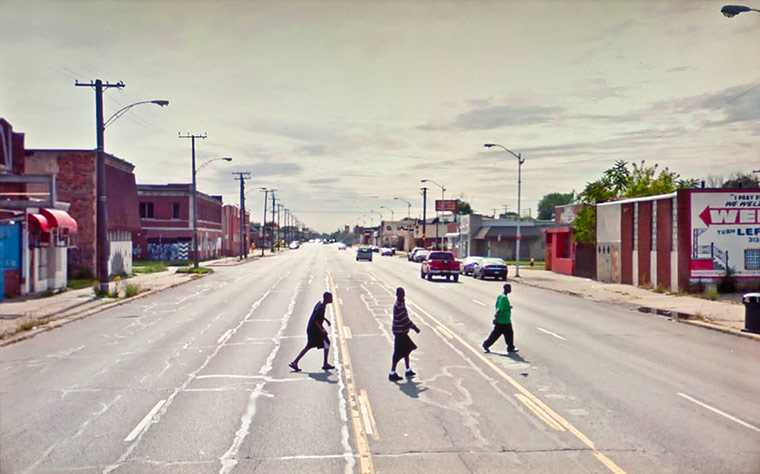
The Guardian recently ran a piece on how documentary photograph-minded users of Google Street View troll it for unintentionally resonant images of street life. They then display these found images as documentary photography.

Whatever you think of photographers (can they just sit and search for images?), this is a startling new use of an existing (new) technology, and right up the alley of really new media.

Wednesday, June 20, 2012

Coca-Cola? Here?

I'm the last person who expected a promotion by Coca-Cola to appear here.

But, heck yeah, I'm still clean--the promotion actually isn't by Coke, but by a re-imagining/ updating of its (in)famous "Hilltop" ad from decades ago.

Some pretty cool really-new-media thinking. Its some of the best concepting I've seen since my all-time favorite (and still living in concept only) "Durex Baby."

Stretching QR Codes

We've been told that QR codes are old hat (soooooo 2011!). And they are, due to the old-hat ways in which they are still being used.

Leave it to artists such as Yiyung Luto start to imagine new uses, and thus to bring the technology into the realm of really new media.

Integrating a QR code into each finished illustration takes users to a video stop-action animation of the making of that illustration.

See more at her website.

Thursday, June 14, 2012

It Tells a Story

The best way to avoid disconnected, myopic emphasis on devices at the expense of uses and relevance is to understand how new media might fit into what one could call the relevant story.
A relevant story is something that already exists--the new media devices don't create it. But it is relevant to the market, and it meshes tightly with their lives. Because it is relevant to a target market, it is specific to it. There's no way to export a good use of new media generally, because the story it works with and within is specific, not general
Case in point is the Toyota campaign released in Belgium that works with Google Maps. It fits specifically the lives of people living in those narrow streets, and it works with their pride in living where they do, plus their desire to help put their neighborhood on the map.

Thursday, May 31, 2012

Yet another technology looking for a use

Leave it to the Aussies to extend (in this case) the social-media practice of trending (back) into the real world of people, bodies, and face-to-face discussion in one big, giant buzzing visualization.
Clemenger BBDO Sydney describes its project as "Mimeisthai - the world's first spoken-word trending engine."
Drop those smart phones, and forget texting, tweeting, etc. A series of mics throughout the auditorium picked up and digitized snips of f2f discussions, then crunched them into a visual representation of topics in conversation that were trending.
Like other examples noted here previously, it represents a great potential--if only now someone figured out a compelling use beyond a roomful of tech-nerds.

Thursday, May 3, 2012

Ignore the Cheesy Campaign Name

Forget the "Emart Sunny Sale" campaign. But pay attention to how it connects the medium (in this case QR codes) to the time as well as the place in which users encounter them.

The QR code can only be scanned during certain times of the day.

It's some great thinking that takes this technology and adds relevance.

Thinking the Future iPhone

Really new media need to be thought. It's not enough to simply invent a cool device then wait for someone to figure out what to do with it.

For example, pair the current craze for holograms (think augmented reality) with the craze for the iPhone.

What do you get?

Some pretty cool ideas about what could be.

Thursday, April 5, 2012

Another Device To Yet Have a Use


On the heels of my last post comes this gizmo from Google Labs, the AR eyeglasses.
Who needs a screen and interface in front of your hands when you can have one in front of your eyes?
While it too has yet to reach the level of really new media, it is ripe for really-new-media thinking.

Friday, March 30, 2012

Another Tech Still To Become Really New Media

Here's another example of an intriguing technical capability. It has yet to reach the level of really new media because no one yet know quite what to do with it. But, hey! Just the details...
Matterport is a means by which you can capture 3D environments for later use and manipulation. Now, why I'd want to do that with my office, home, kitchen, etc., I'm not sure. Nor why I'd want to inflict it on others!
But, like my earlier post about Bing Maps and AR, before, this demonstrates not only an intriguing capability yet to be anchored into a compelling use. It also demonstrates the high degree to which the thinking behind media still lags behind technical developments, instead of taking place with them.